Describely
Shortlist for catalog copy rules and advertised CSV/PIM or store connectors.
Verify before choosing: Confirm field mapping, excluded fields, review controls, and whether your connector can publish.
Shopify COMPARISON
Compare catalog copy workflows, fact preservation, enrichment, review controls, and cost per accepted SKU. Inspect the retained public-generator evidence.
Documentation comparison · Reviewed 2026-10-11 · Hands-on test pending
TASK DECISION · REVIEWED 2026-10-11
One title, five bullets, a description, and a separate missing-facts report for the same SKU.
Shortlist for catalog copy rules and advertised CSV/PIM or store connectors.
Verify before choosing: Confirm field mapping, excluded fields, review controls, and whether your connector can publish.
Shortlist for product-information enrichment and bulk content workflows.
Verify before choosing: Separate its public generator from the paid catalog workspace; verify every inferred attribute and destination field.
Both first outputs missed the fixed requirements: the normal case changed material wording and omitted bullets; the boundary case omitted evidence-gap and no-publication explanations.
Scope: Two initial public-utility submissions with a synthetic desk-mat fact sheet. No catalog workspace, ecommerce agent workflow, bulk generation or store publishing was tested.
Recorded 2026-10-04. This is one-sided public-generator evidence. Describely has not been run on the same input here, so this does not establish a winner.
Inspect the retained inputs and outputs →Stop condition: Reject a draft that changes a known fact or invents a claim, even if the copy sounds persuasive.
Download the shared evaluation brief (.txt) ↓Use one currency and the same batch period. Enter your actual costs, including failed attempts. This calculator stays in your browser and does not save or send these values.
Formula: (allocated software + usage and other charges + hours × hourly cost) ÷ accepted outputs. This is your estimate, not a vendor price or measured benchmark.
Official product documentation reviewed on 2026-10-11. Feature descriptions are vendor claims; the recorded execution above, where present, has its own date and scope. These hosted products were not reverse engineered or tested with REA.
For open-source agents, our sister site uAgentKit separates source inspection from native execution. Both sites are operated by the same team.
Choose by the catalog workflow you need to verify: draft creation, attribute enrichment, or approved publishing. Neither a connector list nor a fluent description establishes factual accuracy.
| Compare | Describely | Hypotenuse AI |
|---|---|---|
| Workflow to evaluate | Catalog content rules, copy generation, and advertised store or CSV/PIM connectors | Product-information enrichment, bulk content generation, and catalog workflows |
| Input control | Check mapped product fields and brand rules | Check source data and how enriched attributes are verified |
| Execution evidence here | No same-input execution recorded | Public generator outputs retained; paid catalog workspace not tested |
| Before publication | Review facts and destination field mapping | Review facts, enriched values, and destination field mapping |
Start with the shared synthetic SKU brief above. Keep the accepted facts and requested fields identical. Record edits, omissions, unsupported claims, review time, and the exact feature used. A public generator and a connected catalog workspace are different workflows.
Unknown product attributes should remain unknown until a source is available. Keep enrichment suggestions separate from approved facts. Preserve the original catalog export and verify one reviewed product before enabling a batch publishing workflow.
Current feature availability, integration, and pricing should be confirmed with the vendor. No paid placement or third-party affiliate link is used in this comparison.

Generate and enrich product content in bulk, with catalog imports and advertised Shopify publishing.
Pay per product · High-volume quote
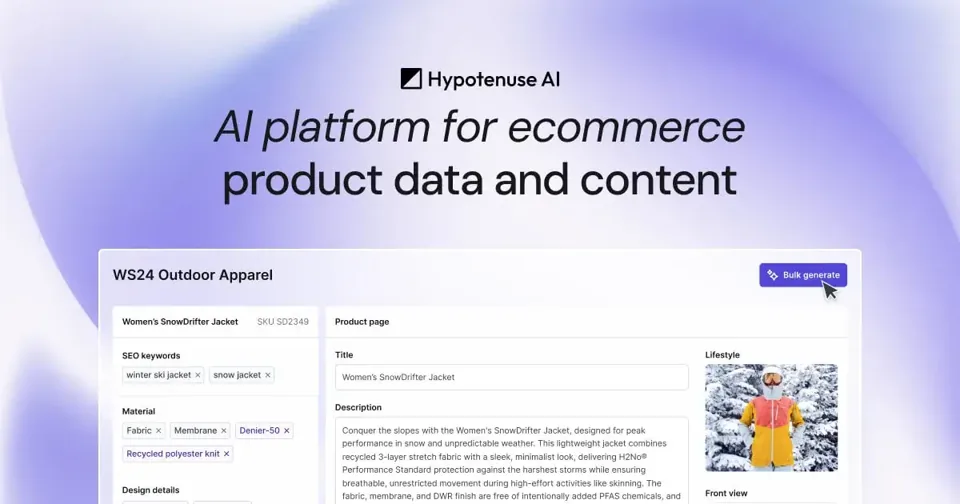

Specialized catalog agents for product data, descriptions, image preparation, and approval-based content workflows.
Custom ecommerce plans · Trial advertised